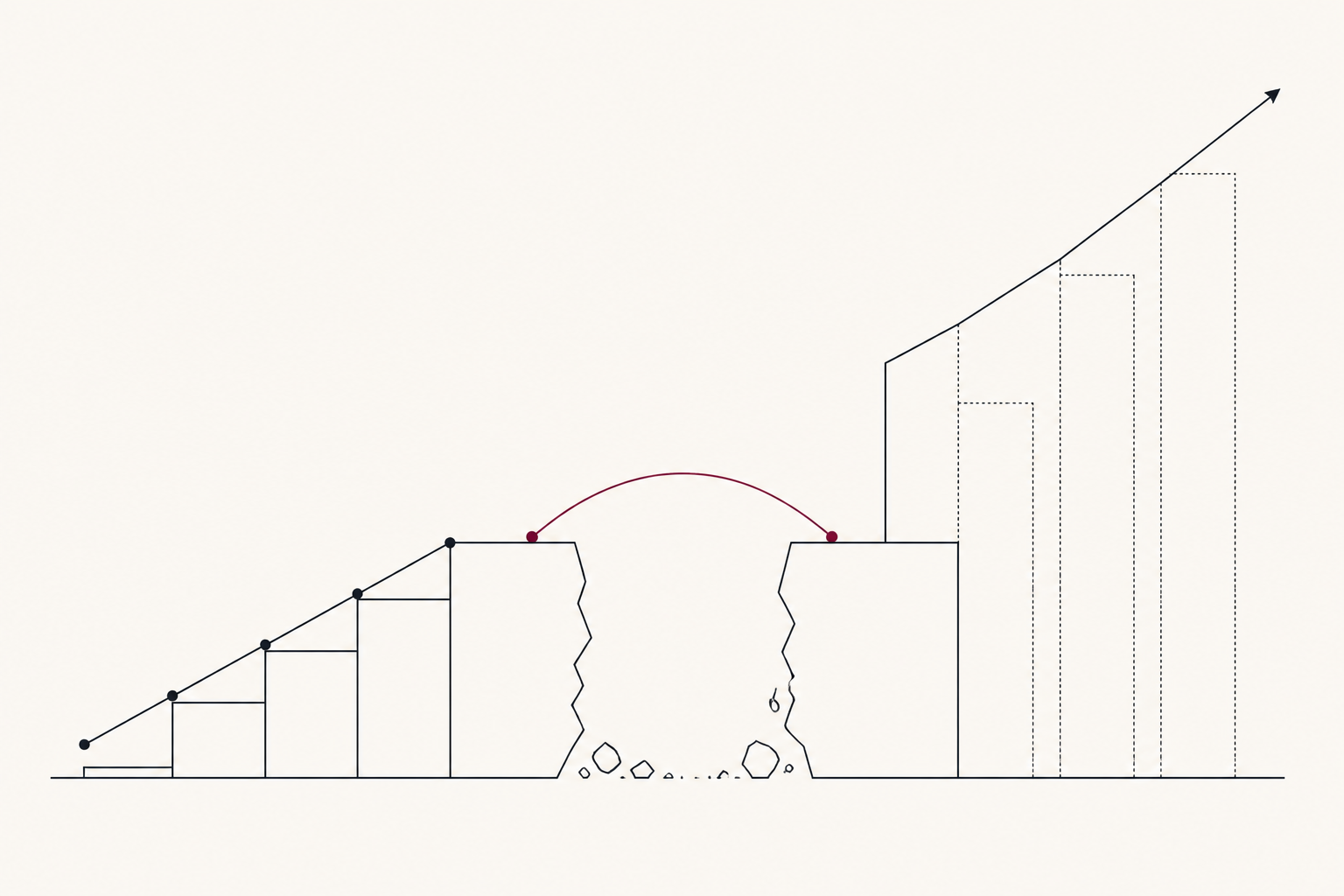
SyncI&DLabs reads Canada’s innovation economy the way people embedded in it do. The district exists to close the gaps below. This is the national diagnosis it answers, drawn from the country’s own institutions.
A Country That Exports Its Own Advantage
In March 2024, the Senior Deputy Governor of the Bank of Canada, Carolyn Rogers, gave a speech with an unusually blunt title: it was time to “break the glass” on Canada’s productivity emergency. A central bank does not use the word emergency lightly. [1] Bank of Canada, 2024 Rogers, C. (2024). Time to break the glass: Fixing Canada's productivity problem. Bank of Canada, remarks, 26 March 2024. https://www.bankofcanada.ca/2024/03/remarks-2024-03-26/ Her figures were stark. Canadian productivity had fallen to roughly 71 percent of the US level, down from about 88 percent in the mid-1980s. Business investment per worker had lagged the United States for decades. The country’s output per hour had barely moved in years.
The paradox is that the inputs are strong. Canada trains world-class talent and produces genuine research. The Council of Canadian Academies calls the higher-education sector “a rare bright spot.” The outcomes are where the country falls short.2 Council of Canadian Academies (2025). The State of Science, Technology, and Innovation in Canada 2025. The outcomes are where the country falls short.2 The value of what Canada makes leaves: talent to the United States, intellectual property to foreign owners, scale-up returns to whoever leads the round.
The Five Gaps
- Long-term investment and risk aversion. Capital investment per worker is lower than it was a decade ago; productivity is roughly unchanged from seven years ago.
- Commercialization and scale-up. R&D intensity sits at 1.81 percent of GDP against an OECD average of 2.73 percent.
- Strategic vision and coordination. The CCA describes a “highly fragmented system” with “incomplete and dated frameworks.”
- IP ownership and retention. Foreign-controlled firms own 44.3 percent of Canadian manufacturing assets.
- Talent retention. A rare bright spot at risk: Canada trains the talent, and too often another country employs it.
Each gap is measured, not asserted. Together they describe a country that generates advantage and then exports it. The district is built to keep more of that value in Canada, venture by venture.